
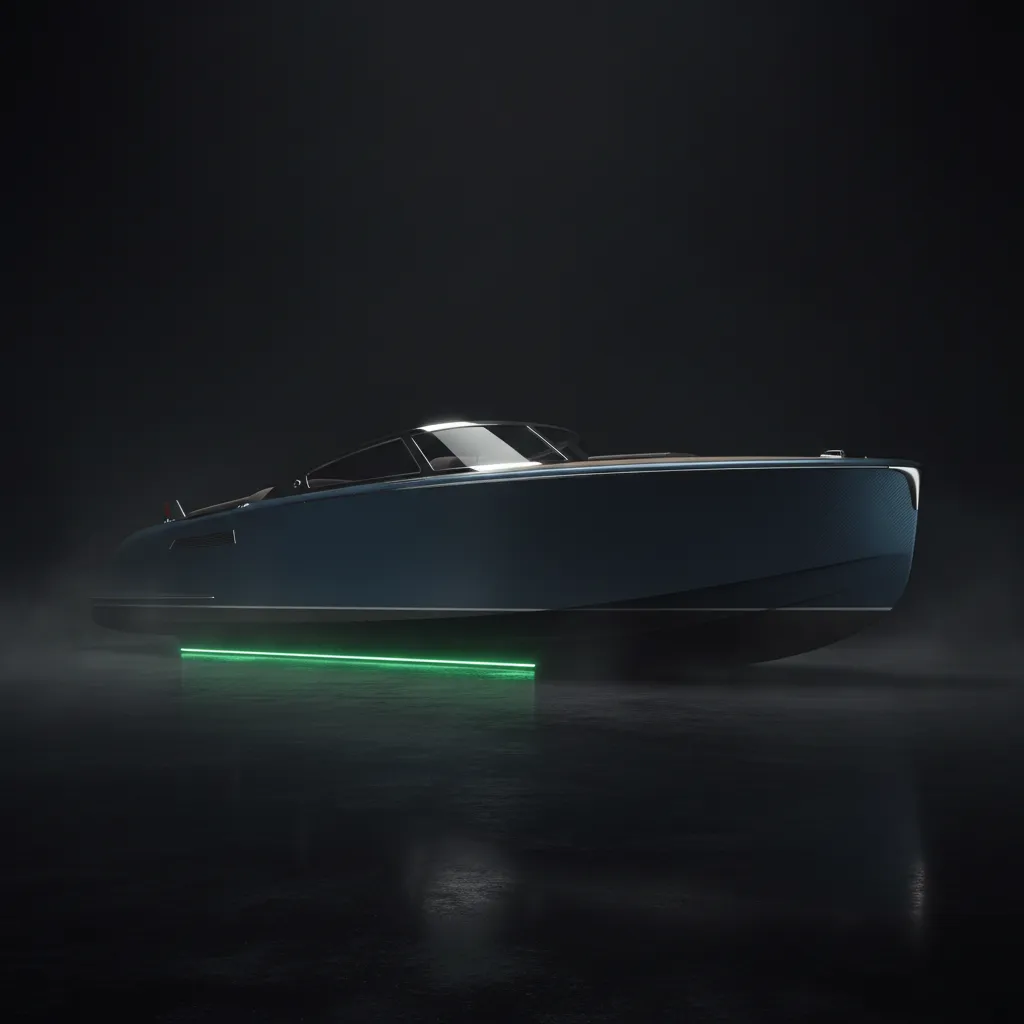
The water has always demanded different engineering from the road. Salt spray, constant vibration, limited space, and nowhere to pull over when something goes wrong. These realities have made marine propulsion one of the most demanding applications for any power system.
Now, as electric marine propulsion transforms the industry, two factors stand out as critical for success: silent operation and thermal management, and Powered by Everrati is uniquely positioned to tackle them.
The Marine Electric Advantage
Battery-powered boats represent more than just swapping diesel engines for electric motors. They’re fundamentally changing what’s possible on the water, from luxury yachts to commercial vessels to high-performance recreational craft.
The most immediately noticeable difference? The silence. Modern electric propulsion systems for ships operate with a whisper compared to the rumble and vibration of traditional engines. This isn’t just about comfort, though that certainly matters. Silent operation opens up entirely new possibilities for how vessels are used and experienced.
Why Silent Operation Changes Everything
Enhanced Onboard Experience
On luxury yachts and cruisers, engine noise has always been the compromise you accepted for propulsion, but not anymore. Electric marine propulsion eliminates the constant background drone, transforming the onboard environment.
- Conversations happen naturally.
- You can hear the water against the hull.
- The experience becomes immersive rather than combative.
This silence also eliminates vibration, which subtly fatigues passengers and crew over longer journeys. The smooth, quiet operation of electric systems creates a more refined experience that’s immediately noticeable.
Wildlife and Environmental Considerations
For research vessels, wildlife tour boats, and fishing boats, silent operation provides clear operational advantages. Marine life is far less disturbed by electric propulsion, allowing closer observation without being bothersome. This matters for scientific research, ecotourism, and catch success rates.
Harbors and marinas increasingly value quiet vessels as well. Noise regulations are tightening in many waterfront areas, and electric propulsion sidesteps these restrictions entirely.
Tactical and Commercial Applications
Silent running has obvious advantages for certain commercial and security applications. Patrol vessels, support craft, and specialized work boats all benefit from less noise. The ability to maneuver quietly near structures or in sensitive areas expands their capabilities.
Thermal Management: The Marine Challenge
If silence is the most obvious benefit of electric marine propulsion, thermal management is the most important engineering challenge. Water is an excellent cooling medium, but the marine environment creates unique complications that demand sophisticated solutions.
The Salt Water Problem
Unlike automotive applications, where coolant can be routed to external radiators, marine systems must manage heat without relying on direct seawater cooling for sensitive electronics. Saltwater is incredibly corrosive and cannot contact batteries, power electronics, or control systems. This requires closed-loop cooling systems that transfer heat well while staying completely isolated.
Continuous Load Conditions
Boats often operate at sustained high power for extended periods. Unlike cars with varied duty cycles, a cruising vessel might run at 60 to 80% power for hours. This continuous thermal load requires cooling systems that can handle sustained heat rejection without oversizing components to the point of being impractical.
Space and Weight Constraints
Marine vessels are incredibly sensitive to weight distribution and are constrained by physical dimensions. Thermal management systems must be compact and strategically positioned to maintain proper balance while providing adequate cooling capacity. This often means innovating heat exchanger designs and intelligent coolant routing that maximizes efficiency within tight packaging constraints.
Temperature Extremes
The marine environment swings from freezing conditions to tropical heat, sometimes within a single trip. Thermal management systems must perform across this entire range while accounting for changing seawater temperatures that affect cooling efficiency.
Everrati’s Marine Expertise
At Powered by Everrati, we understand that successful electric propulsion systems for ships require more than just adapting automotive technology. Marine applications demand purpose-built solutions that account for the unique challenges of operating on water.
Our approach integrates:
- Advanced thermal management designed specifically for marine duty cycles
- Sealed, corrosion-resistant components that withstand harsh environments
- Sophisticated battery management that accounts for vessel motion and load variations
- Power delivery systems optimized for both efficiency and performance
Whether you’re developing luxury yachts, commercial vessels, or specialized craft, we bring the engineering expertise that makes electric marine propulsion reliable, efficient, and exceptionally refined.
Ready to explore what electric propulsion can do for your marine application? The future of boating is silent, efficient, and remarkably capable. Let’s discuss how Powered by Everrati can help you navigate the transition to electric marine power.