
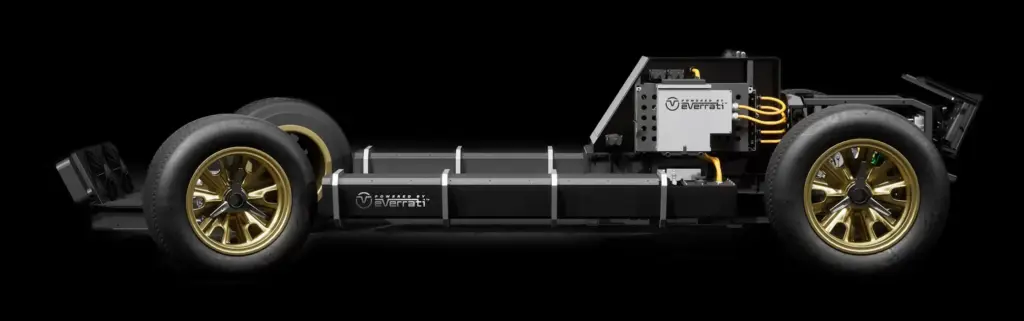
If you’re creating electric vehicles in small quantities, you know how it presents unique challenges. Unlike mass-market manufacturers who can spread development costs across millions of units, low-volume producers need solutions that deliver without massive upfront investment. This is where modular EV battery systems from Powered by Everrati change the game, offering flexibility, scalability, and speed to market that traditional custom battery packs simply can’t match.
Introduction to Modular EV Battery Systems
A modular EV battery system is built from standardized, self-contained units that combine in various configurations to meet specific energy and performance requirements. Think of them as building blocks. Each module contains its own cells, monitoring systems, and thermal management, allowing them to be arranged in different quantities and layouts depending on the vehicle’s needs.
This contrasts with fully custom battery packs, where every component is designed specifically for one application. While custom packs might seem ideal, they require extensive engineering, tooling, and testing for each new project. Modular systems provide the performance benefits of a well-engineered battery while maintaining the flexibility to adapt across different vehicle platforms.
The beauty lies in versatility:
- Need more range? Add modules.
- Building a lighter, more agile vehicle? Reconfigure the modules to deliver higher voltage with less mass.
- Adapting to a different chassis layout? Reconfigure the module placement.
Our ability to keep design flexible proves invaluable for manufacturers working on multiple vehicle variants or evolving designs.
Benefits for Low-Volume Manufacturing
Reduced Investment and Faster Development
For low-volume EV manufacturing, using capital efficiently makes the difference between feasibility and fantasy. Custom battery development can require millions in engineering, testing, and tooling before producing a single pack. Modular systems eliminate much of this burden by using proven designs that are ready to integrate.
Development timelines shrink dramatically with Powered by Everrati. Instead of spending 18 to 24 months developing and validating a custom battery architecture, manufacturers can move from concept to production in a fraction of that time. Speed matters when you’re bringing limited-production vehicles to market or responding to customer demand for bespoke builds.
Simplified Maintenance and Future-Proofing
Modular batteries offer practical advantages during ownership also:
- Technicians can replace individual modules rather than entire battery packs
- There’s reduced downtime and lower repair costs
- There are clear upgrade paths as battery technology evolves
- Customers can benefit from newer chemistry with improved energy density years later
You’re not just building a vehicle. You’re creating a platform that can evolve.
Scalability Across Product Lines
The same core modules can serve multiple vehicle applications with different performance levels. A sports car might use high-power modules arranged for maximum performance, while a grand tourer could prioritize capacity modules configured for extended range.
It’s transformative economics for small-volume manufacturers. Rather than engineering separate battery systems for each vehicle variant, you’re working with a flexible toolkit that adapts to different applications. Development focuses on integration and optimization rather than reinventing fundamentals every time.
Design Considerations
Module Architecture and Flexibility
Size and capacity need to balance packaging efficiency with flexibility. Modules that are too large limit configuration options, while units that are too small are too complex to assemble and manage.
The electrical architecture connecting these modules is equally important. Modern modular systems use sophisticated battery management that monitors each module’s health, temperature, and state of charge while balancing loads across the entire pack. As a result, you get optimal performance and life, regardless of how modules are configured.
Thermal Management and Safety
Thermal management becomes more complex in modular systems since each module generates heat that must be removed safely. The best designs integrate cooling into the module itself, creating self-contained units that stay within optimal operating temperatures, regardless of their position in the vehicle.
Safety mechanisms must also be designed with modular systems in mind, including:
- Continuous isolation monitor across all modules
- Advanced fault detection and controlled emergency shutdown capabilities
- Reliable communication protocols between modules
- Ensuring the entire system operates harmoniously as a whole
Performance Optimization
Modular battery systems give you lots of options, but they still need to work well. To get the best results, the way modules connect should keep resistance and voltage drop low, while staying strong and secure. With good design, a modular battery can be just as powerful and efficient as a custom-built one.
Getting the most range is about more than just how much battery you have. Where you place the modules changes the weight and how the vehicle handles. Smart positioning can actually make the car perform better by lowering its center of gravity and improving balance, which helps with driving overall.
Applications in Specialty & Niche Vehicles
Classic Car Electrification
Modular battery systems are especially useful when electrifying classic cars to electric power, because every car has its own space and design challenges. Since older vehicles weren’t built to hold batteries, being able to arrange battery modules to fit around the car’s existing framework is a big advantage. You can place these modules in different areas of the car, making it easier to work with whatever space is available:
- Former fuel tank locations
- Transmission tunnels
- Custom underfloor enclosures
- Strategic positions that maintain the vehicle’s original character
Limited-Run Performance Vehicles
For specialty manufacturers and prototype developers, modular systems provide the performance and reliability required while keeping development timelines realistic. These vehicles demand exceptional power delivery and thermal management, requirements that well-engineered modules immediately satisfy. The ability to validate battery performance before completing vehicle development reduces risk significantly.
Commercial and Recreational Applications
Small-series commercial vehicles, specialty recreational EVs, and custom applications can all benefit from modular battery approaches. Whether building electric delivery vans, off-road vehicles, or marine vessels, the fundamental advantages remain constant: faster development, lower investment, and proven reliability.
Everrati’s Approach
At Powered by Everrati, we’ve developed modular battery systems specifically for the challenges of low-volume production. Our approach combines proven module designs with flexible integration strategies that adapt to a wide range of vehicle architectures, and it’s what sets us apart.
Our modular systems deliver the performance metrics that discerning clients demand:
- High power density for exhilarating acceleration
- Sophisticated thermal management guarantees consistent performance
- Comprehensive monitoring and protection systems
- Long-term reliability you can count on
We collaborate closely with vehicle manufacturers to tailor the module configuration for each unique application. This could involve arranging modules to optimize weight distribution, setting up connections to deliver maximum power, or designing enclosures that fit seamlessly within the vehicle’s structure. While modularity offers flexibility, our engineering expertise ensures that this flexibility consistently leads to the best possible performance.
Our relationship with manufacturing partners extends beyond initial vehicle production. We provide technical support for service procedures, supply modules for warranty replacements, and offer upgrade paths as battery technology advances. You’re not just sourcing components but partnering with a team invested in your long-term success.
Explore Solutions with Powered by Everrati
For manufacturers entering low-volume EV production or established builders seeking more flexible battery solutions, modular systems are a strategic advantage. At Powered by Everrati, we provide the technology, expertise, and support that transform complex battery systems into a competitive advantage. Let’s discuss how modular battery solutions can accelerate your electric vehicle program.
FAQs/Considerations for Manufacturers
- How do modular systems compare to custom packs in performance?
Modern modular battery systems match or exceed custom pack performance when properly engineered. Custom packs might package slightly more efficiently in one specific vehicle, but modular systems offer 90 to 95 percent of that efficiency while providing vastly greater flexibility.
- Can modules be upgraded over time as technology improves?
Yes. Module upgrades become feasible as battery technology evolves. Chemistry improvements, increased energy density, or enhanced thermal management can be incorporated to remain compatible with existing electrical architecture and mechanical interfaces.
- What are the cost implications for low-volume production?
While individual modules might cost more per kilowatt-hour than cells in a custom pack, total program costs favor modules for low-volume applications. Eliminating custom development, tooling, and validation expenses typically results in lower overall investment, particularly for manufacturers building fewer than 500 units annually.
- What about safety and compliance considerations?
Pre-validated modular systems simplify compliance with safety standards. Testing and certification are completed at the module level, reducing the burden on vehicle manufacturers. Integration still requires proper engineering and validation, but you’re building on a foundation that’s already proven rather than starting from scratch.